
 中文简体
中文简体
 English
postmaster@goobagelfood.com
Content
- 1 Three Ingredient Families Driving Specialty Baking in 2026
- 2 Comparing Specialty Ingredient Categories Before You Spec
- 3 Consumer Signals Hidden in Early 2026 Data
- 4 Where Adoption Is Concentrated Across Bakery Channels
- 5 Five Steps from Ingredient Trend to Production Ready
- 6 Maintenance, Labeling, and Compliance Notes
A bakery category manager at a regional coffee chain opened three supplier spec sheets on the same Monday morning. One recommended a protein-fortified bagel base. Another proposed a sourdough preferment for deeper crust character. The third suggested replacing artificial preservatives with a fermented clean-label system. Each made sense on its own. Together, they forced the same question: which specialty baking ingredients actually deserve a 2026 product development budget?
High-value conclusion: Specialty baking ingredient choices in 2026 come down to three integrated priorities: texture contrast, functional nutrition, and label simplicity. Bakers get the best return when they commit to one or two of these priorities and validate them against dough performance. Trying to follow every trend at once is the most expensive approach.
Three Ingredient Families Driving Specialty Baking in 2026
Texture-controlled flours and inclusions
With 71 percent of consumers now ranking texture at least as important as flavor, suppliers are responding with specialty wheat flours, enzyme systems, and water-rinsed dough techniques that build contrast between a firm crust and a chewy interior. Bagels remain a useful reference because the traditional kettle-boiled step creates exactly this dual texture. A practical example is a dark whole-wheat multigrain bagel with oat and flax inclusions, which delivers whole-grain appeal and a visible seeded crumb in one SKU.
 Dietary Nutrition Dark Whole Wheat Multigrain Bagel Manufacturers, Suppliers, WhGoobagel - China Dietary Nutrition Dark Whole Wheat Multigrain Bagel Suppliers and Wholesaler, Custom Dietary Nutrition Dark Whole Wheat ...View Product →
Protein and fiber concentrates
High-protein and fiber-rich baked goods are now expected across retail and foodservice menus. Wheat protein isolate, pea protein, chickpea flour, and oat fiber support credible nutrition claims, but the tolerance window in lean dough is narrow: roughly 3 to 8 percent flour substitution before water absorption, mixing time, and crumb structure change. One efficient format is a chewy bagel base filled with spiced chicken, which combines dough structure, satiating protein, and a distinct flavor profile.
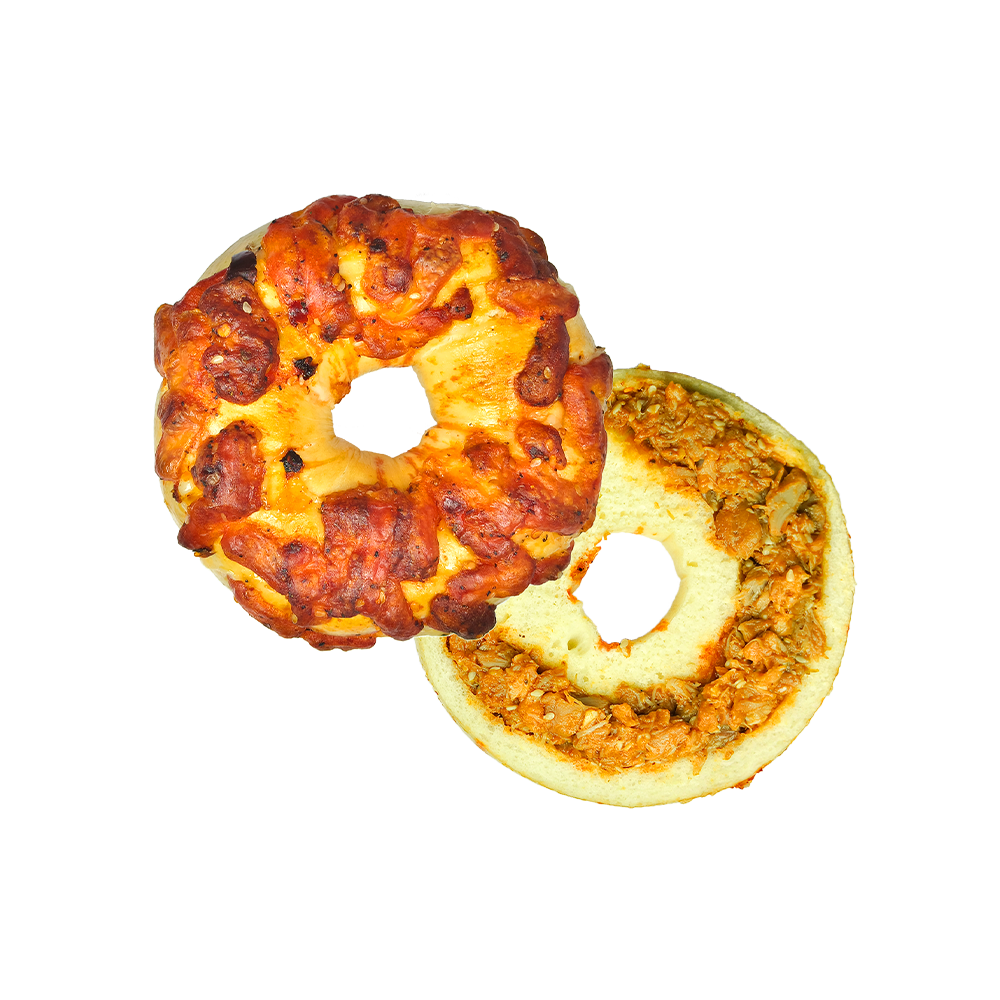 Chewy Bagel Base Teng Pepper Chicken Bagel Manufacturers, Suppliers, WholesalersGoobagel - China Chewy Bagel Base Teng Pepper Chicken Bagel Suppliers and Wholesaler, Custom Chewy Bagel Base Teng Pepper Chicken Bagel M...View Product →
Clean-label ferments and natural shelf-life systems
Sourdough, inactivated yeast, and fermented citrus or fruit extracts now replace chemical preservatives in many bakery formulas. The label becomes shorter and more transparent, but fermentation behavior becomes less predictable, so suppliers need validated manufacturing data. Manufacturers entering this space can review clean-label bagel formulations without preservatives to see how the component ratios work in practice.
Comparing Specialty Ingredient Categories Before You Spec
The table below summarizes the ingredient categories most frequently evaluated in 2026 bakery briefs. Use the ranges as planning tolerances, not universal specifications; dough hydration and equipment type will shift them.
Table 1. Typical formulation ranges for common specialty ingredient categories in 2026; exact figures depend on dough type and line configuration.
Consumer Signals Hidden in Early 2026 Data
The most useful data is not about which ingredients consumers name, but which attributes they refuse to compromise on. Early 2026 surveys consistently rank texture at the top.
Texture
Protein
Clean label
Plant-based
Whole grain
Figure 1. Share of consumers ranking each attribute as a primary repeat-purchase driver, based on early 2026 bakery category surveys.
The takeaway for buyers: texture is no longer a second-tier attribute. It drives repeat purchase because a crisp first bite and a dense, chewy center create a physical memory of the product. That is why seeded and multigrain lines keep gaining shelf space: visible inclusions and surface seeds deliver a tactile experience before the first bite.
Where Adoption Is Concentrated Across Bakery Channels
Specialty ingredients are not spreading evenly across the market. The channel mix below reflects where product developers are placing their largest bets in 2026.
- Retail bakery and in-store bakery - 30%
- Coffee and tea chain menus - 28%
- Foodservice and QSR - 25%
- Convenience and grab-and-go - 17%
Coffee and tea chains carry a disproportionate share of specialty bagel ingredient volume because their menus are controlled, heating instructions are consistent, and customers already accept a premium price for a customized morning item. For the same reason, frozen formats that remove in-store baking complexity perform well in this channel.
Five Steps from Ingredient Trend to Production Ready
- Define the consumer claim. Write the exact wording your label will carry. "Good source of protein" and "no artificial preservatives" require different ingredients, different costs, and different validation timelines.
- Benchmark your current SKU. Measure water absorption, bake loss, crumb firmness, and ambient shelf life before changing the formula. Without a baseline, you cannot prove the new ingredient worked.
- Run small pilots. A pilot line of salted sesame bagels made from high-quality wheat sources
 High-Quality Wheat Source Salted Sesame Bagel Manufacturers, Suppliers, WholesalGoobagel - China High-Quality Wheat Source Salted Sesame Bagel Suppliers and Wholesaler, Custom High-Quality Wheat Source Salted Sesame B...View Product →, for instance, quickly reveals whether a seeded surface survives both the oven and the blast freezer.
 - Lock the process with a frozen format. Once the formula works on a pilot line, parbaked frozen bagel formats for foodservice reduce the risk of inconsistent finishing at store level and shorten the training curve for new staff.
- Verify and iterate. Track crumb firmness, moisture migration, and sell-through for at least four weeks before extending the line. Small adjustments to inclusion size or proof time often matter more than the headline ingredient.
Maintenance, Labeling, and Compliance Notes
Specialty ingredients raise the same operational questions every time: allergen control, shelf-life proof, and supplier documentation.
- Allergen declarations. Sesame, wheat, gluten, dairy, soy, and egg must be declared accurately on packaging for each region you sell into. A seeded line changes the allergen profile of your entire production site.
- Cross-contact management. If you introduce sesame or other seed inclusions, decide whether to run dedicated lines or validated cleanouts. Residue between runs is the most common cause of recall in specialty bakeries.
- Shelf-life validation. For preservative-free formulations, validate at least 12 weeks of frozen stability plus the intended ambient window. Supplier data alone is not sufficient for your specific oven profile.
- Documentation. Keep batch-level records of specialty ingredient lots so any quality deviation or labeling claim can be traced back to the source ingredient and processing step.
Specialty baking ingredients are not a single purchase decision. They are a system of claims, tolerances, and process constraints. In 2026, the bakers who win are the ones who choose fewer trends, test them harder, and scale only what survives contact with their own freezers and ovens.
